01 /
Intelligence proposes.
Models reason, generate options, and recommend actions. Useful possibilities, not automatic authority.
01 / THE PROPOSALSYSTEMS THINKING FOR AGENTIC AI / VOL. 01
Intelligence is not the system. The system is.
A practical field guide and interactive framework for engineers building reliable LLM and agent systems. Connect reasoning, evidence, tools, control, and recovery into one accountable architecture.
Read a free first-edition chapter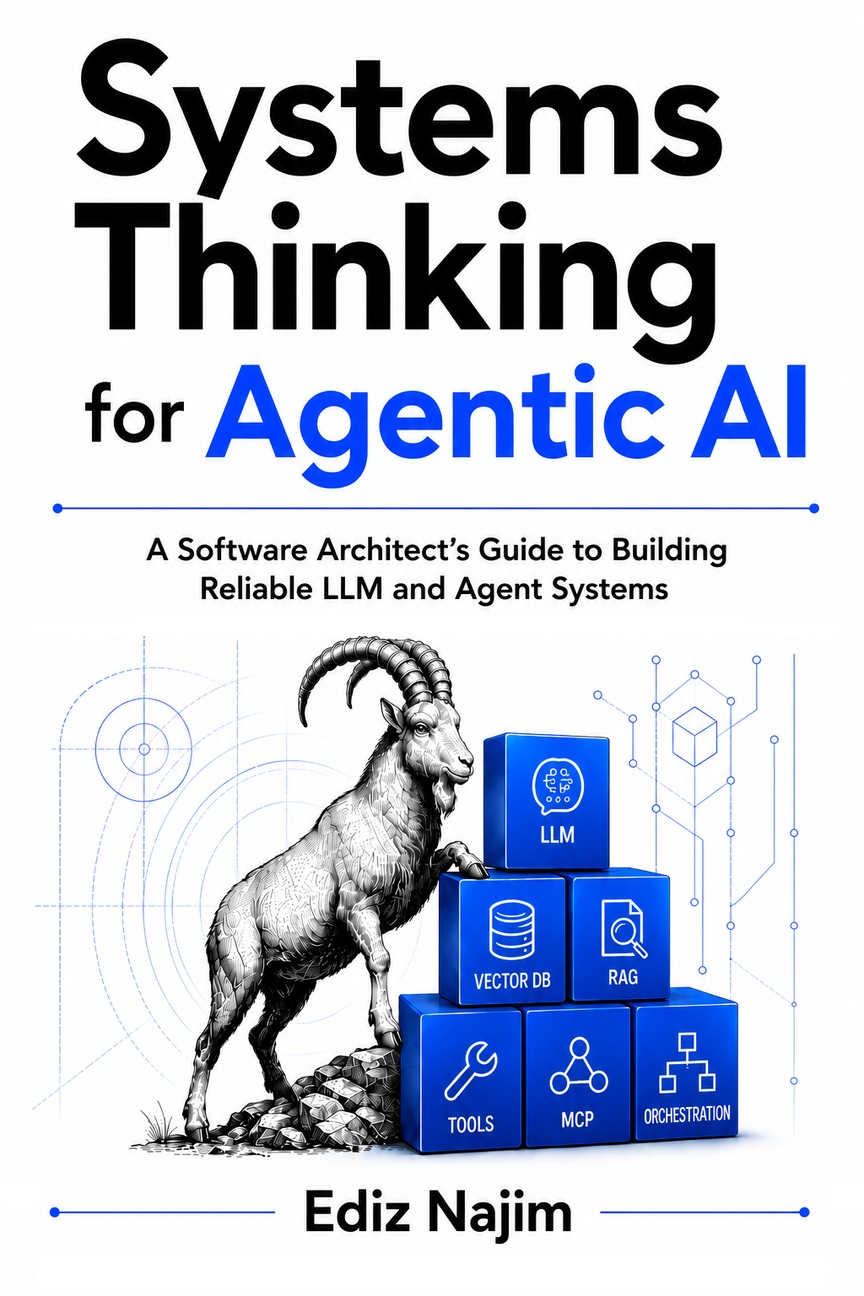
Great AI engineering starts where model output ends: with control, contracts, state, evidence, verification, and clear ownership.
STAAI means Systems Thinking for Agentic AI.
Models reason, generate options, and recommend actions. Useful possibilities, not automatic authority.
01 / THE PROPOSALPolicy, schema validation, permissions, and guarded execution turn proposals into bounded actions.
02 / THE BOUNDARYHuman review, observability, recovery, and escalation keep accountability where it belongs.
03 / THE RESPONSIBILITY02 / INSIDE THE ARCHITECTURE
Seven layers. One connected system.
Choose a numbered layer to explore its role.
CONCEPTUAL MODEL · SELECT A NUMBER TO EXPLORE
LAYER 04 / CONTROL
Check permissions, schemas, guardrails, and approval requirements before a proposed action reaches a real system.
IN PRACTICE
A proposed tool call is validated against its schema and the user’s permitted scope before execution.
Try the deployment control in the labPick a mission, inject a failure, and see exactly where an AI agent should stop, act, or recover.
LOCAL SIMULATION · SYNTHETIC DATAThe interactive lab needs JavaScript. You can still read the first-edition chapter or explore the architecture.
Diagnose a 5xx spike without changing production.
READ-ONLY EXECUTION“Find why search-api is returning 5xx errors. Do not modify production.”
Identity: on-call engineer · Scope: search-api · Permission: observability.readTry a failure. Turn off the policy gate, require approval, or inject a timeout to see where control matters.
Click any checkpoint to inspect its contract and engineering decision.
Select a control point to inspect its decision, contract, and evidence.
A generated recommendation and an authorized system action are different things.
// No operation has been proposed.
// The model has no direct tool authority.EXPERIMENT: CHOOSE DEPLOY TO PRODUCTION → RUN WITHOUT APPROVAL → GRANT APPROVAL → INJECT VERIFICATION FAILURE.
A Software Architect's Guide to Building Reliable LLM and Agent Systems
Go beyond disconnected patterns and learn how LLMs, RAG, memory, MCP, tools, orchestration, guardrails, evaluation, and recovery fit into one coherent production system.
Six control areas. Thirty-six engineering principles. One consistent philosophy: autonomy must be bounded, observable, and recoverable.

SOFTWARE ARCHITECT · TECHNICAL LEAD · AUTHOR
Exploring how AI agents become reliable software systems, not just impressive demos. Connecting distributed systems thinking with practical engineering for the age of agency.
Publishing, speaking, collaboration, and conversations about the engineering behind AI.
ediz.najim@staaicore.com